October 23, 2021

SECAR and our search for scientific integrity


(This blogpost will be updated regularly according to new finding in our investigation)

The fact that local archaeological organization SECAR (St. Eustatius Center for Archaeological Research) is able to do archaeological research apparently without adhering to the regulations to which archaeological organizations in the Netherlands are obliged to adhere was shocking to us. We already wrote about the excavations carried out at the Godet site, which is left in a horrible condition and ancestral human remains have surfaced.

We have started our own investigation into the applicable regulations and supervisory authorities to find out who we can hold accountable for this. St. Eustatius is officially a public entity of the Netherlands, but since February 2018 the local government was taken over by the Dutch government. In charge now are two government representatives appointed by the Dutch government.

For readers who are not familiar with the Dutch political situation and governmental structures, we invite you to read the blog post Dutch takeover of St. Eustatius (2018). The Ministry of the Interior and Kingdom Relations is the Dutch ministry responsible for the three Caribbean public entities, Bonaire, St. Eustatius and Saba. These three public entities are often referred to as BES islands. Mr. Raymond Knops is the responsible deputy minster.

Ministry of the Interior and Kingdom Relations

In response to questions on the excavations raised by the Parliamentary Committee of Kingdom Relations, Mr. Knops stated that the archaeological excavations are the responsibility of the government commissioner at the public body of St. Eustatius, and that the role of his ministry and the Ministry of Education, Culture and Science is limited to following the case and giving advice where necessary.

With an archaeological discovery at the scale of the Golden Rock plantation burial ground and the limited resources of the local government that seems very strange to us. Besides that, the local government is in fact the ministry of Interior and Kingdom Relations because there is no elected government at this moment. 

We have tried to get some information from the Ministry itself as well. Our first email to the Public Information of the Ministry went out on July 8, 2021. We asked if we could have a short informative meeting with the responsible department. On August 19, we received a response: "We've looked into it on our side and we come to the conclusion that this is a local matter of the Public Entity St. Eustatius." On October 10, we have refuted that the responsibility lies with the public entity St. Eustatius and have again asked for a short interview with someone within the Ministry. We are awaiting a response to this email. 

Our follow up step is to write to the Parliamentary Committee again.

Ministry of Education, Culture and Science

The Ministry of Education, Culture and Science (in Dutch: ministerie van Onderwijs, Cultuur en Wetenschap, OCW) is responsible for educational, cultural and scientific affairs within the Caribbean Netherlands.

We also asked the ministry of Education, Culture and Science for additional information as there is a department Caribbean Netherlands within the ministry and we feel that as Dutch citizens who have concerns about certain issues it is a democratic right to voice these concerns and to be able to inform ourselves. 

The ministry did let us know that the Higher Education and Scientific Research Act (in Dutch: Wet op het hoger onderwijs en wetenschappelijk onderzoek (WHW) is applicable in Caribbean Netherlands according to Article 1.1a of the WHW  

Our last request for further information and invitation for an informative meeting was sent on October 11, 2021.

National Office for the Caribbean Netherlands

On July 11, 2021, we also asked the National Office for the Caribbean Netherlands (in Dutch: Rijksdienst Caribisch Nederland) for more information on responsibilities regarding archaeological research in Caribbean Research. This office is located on Bonaire and is the link between the ministries that are present on Bonaire, St. Eustatius and Saba. It has a department Education, Culture and Science. The question we asked: "Can you inform us about the (possible) role of the National Office for the Caribbean Netherlands in the case of the excavations on St. Eustatius and the scientific control over SECAR's activities?" We are still awaiting a response, but according the listing of responsibilities on its website, this department is of no importance in relation to archaeological research in Caribbean Netherlands.

KNAW - Controlling body Science

According to the Higher Education and Scientific Research Act The Royal Netherlands Academy of Arts and Sciences (in Dutch: KNAW, Koninklijke Nederlandse Academie van Wetenschappen) has a controlling function in ensuring scientific integrity, ethics, and preventing misconduct. 

We have asked the KNAW about its responsibilities in relation to scientific research in the Caribbean Netherlands. According to the KNAW no scientific research is conducted at SECAR so the KNAW has no responsibilities regarding SECAR. The reason for this is that the archaeologists of SECAR are not affiliated to a scientific organization and publications are not published in academic journals. 

SECAR does work with archaeologist from other countries so will look further into this.

Archaeological and cultural heritage bodies in the Netherlands

In the Netherlands there is a Cultural Heritage Agency and a Information and Heritage Inspectorate. SIKB is a network organization and platform for discussions about quality in archaeology.

  • SIKB - a network in which the private and the public sector strive to continuously and structurally enhance the standards of activities relating to soil management in the Netherlands (in Dutch: SIKB, Stichting Infrastructuur Kwaliteitsborging Bodembeheer) 
See also: Who does what in the care of cultural heritage? (governmental website)


Legislation


The Heritage Act (in Dutch the Erfgoedwet) came into force as of July 1, 2016. The text of the Heritage Act is available in English as well. 

The website of the Information and Heritage Inspectorate states the conditions for excavations:

"It is important that an excavation is carried out carefully and that everything is documented very precisely. Strict rules apply to this. These are laid down in:

The Heritage Act contains a special section on the Dutch Caribbean (Chapter 1.8 page 45) that states that on the following topics in the Heritage Act does not apply to the Dutch Caribbean (Bonaire, St. Eustatius and Saba):

  1. The current legislative proposal
  2. The acts that have been integrated into the legislative proposal
  3. The chapter on management of collections
  4. The implementing legislation for the First Protocol to the 1954 Hague Convention for the Protection of Cultural Property in the Event of Armed Conflict and the 1970 UNESCO Convention on the Illicit Import, Export and Transfer of Ownership of Cultural Property
    (Implementation) Act
  5. Other conventions in the area of cultural heritage do apply in the Caribbean Netherlands, however, including the World Heritage Convention, the UNESCO Convention for the Safeguarding of
    Intangible Cultural Heritage, the Granada Convention, and the Valletta Convention. In so far as necessary, these conventions have been implemented in specific BES Islands legislation.

The section explains: 

For monuments and archaeology, there is a separate act, namely the Monuments and Historic Buildings (BES Islands) Act [Monumentenwet BES]. Based on that Act and the regulations applying to the BES Islands, the island governments can assign protected status to monuments. The Monuments and Historic Buildings (BES Islands) Act comprises a different system of protection to that in the
legislation applying to the European part of the Netherlands. In the European part, the protection of
monuments and archaeology is safeguarded above all in the legislation on spatial planning, and the Caribbean Netherlands has a different regime for that legislation also.


The Monuments and Historic Buildings (BES Islands) Act [in Dutch: Monumentenwet BES]

The Monuments Act BES applies to the Caribbean Netherlands (Bonaire, St. Eustatius and Saba). Executive councils and island councils and owners are responsible for the management and preservation of protected monuments. Archaeological heritage is supposed to fall under what is defined as "monuments" in the act.
 
Artilcle 13 deals with supervising compliance with the act. No more is said than this: "The persons designated for that purpose by the Executive Council are charged with supervising compliance with the provisions laid down by or pursuant to this Act. Such designation shall be published in the Government Gazette (in Dutch: Staatscourant").
 

Then who controls what SECAR does?

In the Heritage Act is stipulated that archaeological excavations must have a certificate. This is regulated in Article 5.1 of the Heritage Act. On the website of the SIKB is a list of certified companies. SECAR is not listed as holder of a certificate. 

Also in the Heritage Act is the obligation to publish a report with the results within two years of completion of that research if archaeological research is carried out somewhere in the Netherlands. 
 
Each report must in any case be delivered to the Cultural Heritage Agency, to the archaeological depot where the findings and documentation are kept, and to the municipality where the archaeological research took place.  

But since the Heritage Act is not applicable in St. Eustatius, SECAR seems to be able to do what it thinks is best. In an earlier stage (June 2021) we contacted SECAR and asked about the research questions on the Golden Rock excavations and what archeological regulations the research team is following. SECAR responded that it works according to the KNA (Quality Standard for Dutch Archaeology) as much as possible. "Given the importance of this location", SECAR stated, "we often go one step further and document in more detail than is strictly necessary". 

Note: The KNA is available in English but based on an earlier version (version 2.1) and is therefore for orientation only -> KNA 2.1 in English  
 
-> KNA in Dutch, version 4.0 for work started after 1 July 2017.
Important to notice is that the KNA is a European based quality standard. Since in the European Netherlands no burial grounds of enslaved Africans exist, the quality standard does not directly deal with archaeological excavations of burial grounds like that. 


The research questions are:


1. Are additional remains of the pre-Columbian Golden Rock settlement present in the research

area that have not yet been excavated by Leiden University in the 1980s?

2. What new information can these remains provide about Saladoid settlement patterns in

general and on the Golden Rock site in particular?

3. What new information can these remains provide about the indigenous peoples’ diets,

funerary practices, inter-island mobility, and exchange networks with other islands?

4. What is the spatial relationship between the burial ground, the slave quarters, and any other

plantation structures at the Golden Rock plantation?

5. How does this spatial relationship compare to other plantations on St. Eustatius and

neighboring islands?

6. What was the socio-economic status of the people buried here?

A. Were people buried in coffins? If so, what materials are they composed of?

B. What types of grave goods accompanied the buried individuals?

C. Are grave markers present? If so, what kinds of grave markers were used?

D. In which positions were these people buried, and is this indicative of religious beliefs?

7. What is the state of preservation of the buried individuals and associated coffins/artifacts?

A. Does the state of preservation vary throughout the site?

B. If so, what taphonomic processes caused varying states of preservation?

8. What can the information provided by the buried human remains reveal about these peoples’

lifeways?

A. What is the ancestry of these people (aDNA study)?

B. What diet did these people have (stable isotope study)?

C. Did these people grow up on St. Eustatius or somewhere else (stable isotope study)?

D. Were these people subjected to infectious diseases (proteomics study)?

E. Do the skeletal remains show evidence of hard physical labor, injury or violence

(osteoarchaeological study)?

9. During which years was the burial ground in use as evidenced from associated artifacts and

14C dating?

10. Have any burials been disturbed, and if so, what caused these disturbances and what is their

nature and extent?

11. How does this burial ground compare to other burial grounds containing people of similar

socio-economic status in the Caribbean region and beyond?


To be continued ...

August 18, 2021

PRESS RELEASE: African descendants in St. Eustatius critically reflecting on the Statia Heritage Research Commission


African descendants in St. Eustatius critically reflecting on the Statia Heritage Research Commission


TILBURG / ST.EUSTATIUS / 15 August 2021 / -- Ubuntu Connected Front


"MISTAKES WERE MADE AND THERE SHOULD AND MUST BE CONSEQUENCES" - SAYS UCF CARIBBEAN CHAIR


Since the announcement of the appointment of the Statia Heritage Research Commission (SHRC) based on a press release of 28 July 2021, we have not heard much on this matter.

Several concerns keep reverberating as time seems to fly by.

How serious should one take these appointments and the establishment of this commission, without an official document other than a press release? This looks like an example of the so-called “Civil Society Advisory Council” which basically still looks like a handpicked group of individuals, under a cloak of a secrecy process, that is conveniently used as a “sounding board”, but lacking proper foundation. In a country where words like “Good Governance”, “Transparency” and “Accountability” seems to be consistently used as a bullwhip to keep others inline, shouldn’t having a decree in place signify the establishment and purpose of the SHRC?

Another concern is, what is the budgetary allotment for the officially not established commission? Is this commission supposed to operate independently from government on a voluntary basis, but lack the authority to pay for coffee, tea and a stick of gum?

Not having these things in place, especially not officially documented leaves the commission very vulnerable. Individuals can be randomly removed or added with very little form of due process, but the reality might be just because they are too critical or their profile falls in line with an expected result. The whatever financial pipe can easily be cut off, just because government does not like what they are hearing through the grapevines.

Operating in an “ad hoc” manner and only saying you are transparent, by whatever government establishment it may be, amplifies the call for the decolonization of archeological research, particularly related to African Diaspora, throughout the Dutch Kingdom. We are also calling on the members of the St. Eustatius Island Council to become more engaged in this struggle. You are the voice of the people!

Are most of the experts of African and other identities, who have the knowledge on this topic in the Caribbean, already incorporated in the SHRC? It seems to have been a strategic move from those in authority for that be the case. They might even have a hand by constructing a non-workable commission. It is like taking a drag net to fish in the Caribbean Sea. It also just seems to be a symbolic and political affair to show that they have support from many professionals.

The overall conclusion of which there can be no denial, is that serious mistakes were made and there should and must be consequences.

The fight and struggle as African people and the descendants thereof, is fighting against the legacy of the Dutch transatlantic slave trade, colonialism, the denial of the right to self- determination, and the continuing impact thereof on the people of African descent.

Our narrative as Africans, aim and vision are about the restoration, bringing dignity and respect to our ancestral remains and our ancestors resting places and spirituality. The crimes that have been committed against our ancestors, are recognized by the UN as a crime against humanity.

Ubuntu Connected Front (UCF) Caribbean, Brighter Path Foundation, and SEAD, welcome the move of the announcement of the appointment of the Statia Heritage Research Commission (SHRC), which is a small step going forward, as to what should have happened from day one. We are far from being satisfied and as such, we will remain vigilant.


###

Further Information: Kenneth Cuvalay

Online Petition: https://www.change.org/LeaveOurAncestorsInPeace

Overview of activities in relation to the objections against the disrespectful excavations of our ancestors: https://afrikanhistoryandconsciousness.blogspot.com/  

UCF, Brighter Path and SEAD are African centered organizations of people of African descent from St. Eustatius.


Press Release agreed and approved by:

  • Xiomara Balentina - President Brighter Path St. Eustatius
  • Derrick Simmons - Coordinator movement Ubuntu Connected Front (UCF) St. Eustatius
  • George Berkel - Vice-president of grassroots movement SEAD (St. Eustatius Awareness and Development Movement)
  • Kenneth Cuvalay - Chairman movement Ubuntu Connected Front (UCF) Caribbean & Tilburg


Ubuntu means "humanity" in African Bantu languages. It is often translated as "I am because we are", or "humanity towards others". It is Ubuntu Connected Front’s core belief that all people have rights, which promotes equality of treatment and eliminates marginalization and deprivation.

The 'Black Agenda' of Ubuntu Connected Front (UCF) can be found in the "Manifest for NL Transformation" at the UCF website (Chapter 5).


July 19, 2021

PRESS RELEASE: Criticism Remains Despite Suspension of Excavations at Caribbean 18C Graveyard


 UCF CARIBBEAN RESPONDS TO SUSPENDED EXCAVATION ST. EUSTATIUS


TILBURG / ST. EUSTATIUS / 19 July 2021 / -- Ubuntu Connected Front
 
 
"One Step Forward – Let’s Work Towards Memory, Repair and True Descendant Engagement" - Says UCF Caribbean Chair
 
 
Despite suspension of archaeological excavations carried out on enslaved ancestors on the small Dutch Caribbean island of St. Eustatius, objections are still being raised. Protest organizers, Ubuntu Connected Front (UCF) Caribbean, Brighter Path Foundation, and SEAD applaud this change in approach by the government, but “We still have many questions and concerns”, says UCF Caribbean chair Kenneth Cuvalay, “it is one step forward, but we are not quite there yet.”
 
Kenneth Cuvalay, "It is smart that our unelected administrators on St. Eustatius have suspended their soulless digging and are going to set up a St Eustatius Heritage Research Commission," Cuvalay points out. "Suspension does not mean discontinuance. Does this mean scientific suspension and discontinuation of our ancestral remains in laboratories outside of St Eustatius? Many people on St Eustatius do not trust the work of SECAR, the local archaeological society. The same organization secretly disturbed graves on the West side of the island and left them in a deplorable state."
 
True transparency and community engagement
 
“And who will be on this commission? Friends of SECAR? More parachuted civil servants from the Dutch mainland? The local government talks about this "group of experts". We have no conservation experts on St. Eustatius – apart from the very self-proclaimed experts who decided to poke around, remove hallowed human remains and artifacts if only to declare that it was scientific work. None of them were born on St Eustatius and yet they broke the faith of their own international archaeological codes.”
 
We have raised concerns, have written letters, and have almost a thousand signatures under the petition. Still no response from the government. From what we read in the government’s press release, our urgent call for more transparency and structural engagement with the descendant community is still not guaranteed. We want a seat at the table; we want to have an input in e.g. knowledge production and the decision-making process; we want our voice included in research planning, design, and interpretation as well. The announced decisions of the government all sounds nice, but is in fact a farce to appease the growing public pressure we made through our letters, the online petition, and media exposure.
 
Objectives still not met
 
“We still would like to get a response to our initial letter to the St. Eustatius government”, the protest organizers state. Questions asked in that letter were:
  1. A written plan on the excavation and commemoration with input from the descendant community and scientists from the Afrikan diaspora;
  2. Establishment of a scientific research protocol including a definitive timeline for completion;
  3. Establish a commemorative proposal that is distinctive and rooted in the history and culture of the Afrikan and Afrikan diaspora. This memorial proposal should include plans for: (a) A respectful treatment of these ancestral remains; (b) Plans for their reburial at the original site of rediscovery; (c) Plan for appropriate Afrika-focused ceremonies as selected by the offspring community; (d)Placement of a permanent memorial on the site of sacred ground (at the airport).
In addition to the above listed questions, we ask:
  1. Input into who will be on the committee of experts, and the Research Commission;
  2. A research and memorialization agreement established between the descendant community and SECAR/St. Eustatius Government;
  3. For SECAR to restore the burial site on the Godet plantation and return the human remains;
  4. All remains of the Golden Rock burial ground to be returned to the island, since the project is now suspended;
  5. Investigation on the granting of taxpayers' money for public relations activities carried out by the wife of the former Commissioner of St. Eustatius for the SECAR digging. It is a matter of record, and we have the records. The souls of the enslaved are tortured twice by this graft.
  6. Make a stand for protecting slave burials, walls, and all monuments that are testimony to heritage.
 Decolonize Archaeology
 
We hold the researchers of the excavations accountable for not to have followed common practices of community archeology. Structural engagement with the public is a common practice in modern archeology. The research team has failed to properly implement this. Especially considering that it concerns a burial ground of our Afrikan ancestors who were victims of horrendous crimes committed against humanity, we regard this as evidence of deep contempt and academic misconduct. It reflects the hundreds of years of racism and white supremacy that we are not prepared to deal with any longer. We therefore want the research team to be replaced and have more Afrikan centered archeologists in charge.
 
Call to the Research Community
 
We need a more collaborative and participatory archaeology in the Netherlands, that has the ethics and sensibility to go into dialogue with us, as the Afrikan descendant community. We need to start an urgent debate on decolonizing Dutch archaeological regulations and practices. Moreover, we need to extend that debate to a global level for there are many more African Burial Grounds at risk in the Americas.


###
 
 
Further Information: Kenneth Cuvalay
Press Release agreed and approved by:
  • Xiomara Balentina - President Brighter Path St. Eustatius
  • Derrick Simmons - Coordinator Ubuntu Connected Front (UCF) St. Eustatius
  • George Berkel - Vice-president of grassroots movement St. Eustatius Awareness and Development Movement (SEAD)
  • Kenneth Cuvalay - Chair Ubuntu Connected Front (UCF) Tilburg & Caribbean
 
UCF Black Agenda
 
Ubuntu Connected Front (UCF) won an absolute majority (50,5%) on St. Eustatius in the elections to the House of Representatives this spring. It is a grassroots community-based movement. Decolonization is on her Black Agenda as part of the party program calling for the decolonization and transformation within structures and systems in the Kingdom to combat systemic racism. The recognition of the impact and legacy of the Dutch transatlantic slave trade and colonization is subject of debate in the Netherlands. Dutch Afrikans in the diaspora are asking the government for apologies for the slavery past, calling for reparatory justice and declaring 1 July (Emancipation Day) a national holiday.
 
Our 'Black Agenda' can be found in the "Manifest for NL Transformation" at the UCF website (Chapter 5).
 
Ubuntu means "humanity" in Afrikan Bantu languages. It is often translated as "I am because we are", or "humanity towards others". It is Ubuntu Connected Front’s core belief that all people have rights, which promotes equality of treatment and eliminates marginalization and deprivation.


July 12, 2021

PRESS RELEASE – Opposition Is Mounting To Archeological Excavations on Caribbean Island St. Eustatius

 PRESS RELEASE – FOR IMMEDIATE RELEASE


Opposition is mounting to archeological excavations on Caribbean island St. Eustatius


TILBURG/ ST. EUSTATIUS - July 12, 2021


"LET OUR ENSLAVED ANCESTORS REST" - SAYS UCF CHAIR

 
Opposition is mounting to archeological excavations carried out on the Dutch Caribbean island of St. Eustatius. Kenneth Cuvalay who is chair of the Caribbean branch of a Dutch political party called Ubuntu Connected Front (UCF) has spoken out against what he calls "the desecration of the human remains of enslaved individuals." 

"We are hoping to protect the resting places of our ancestors," he explains, "These sacred soils should not be disturbed by gravediggers whose only motive is to use taxpayer's money to write academic glory into their own job profiles. They claim their motive is scientific but how many bones do they need to disturb if only to describe the suffering of countless tortured souls?"

Cuvalay is working with various organizations on and outside St. Eustatius on behalf of the people of the small Caribbean island where he was born. President of the Brighter Path Foundation, Xiomara Balentina, is teaming up with UCF in the protests. "St. Eustatius has a history of Dutch colonial rule - like all of the other former five Caribbean islands which were once called the Netherlands Antilles," she states.

A group of international archeologists from the Netherlands, United Kingdom, Finland, Germany and the US has recently excavated the remains of enslaved ancestors in the grounds of the island's airport. "These cultural insensitive foreigners have carried out their toil on our soil. They have done so in a very disrespectful manner without following the protocols for community engagement and properly engaging with the descendant community beforehand as per the international codes of ethics," Cuvalay insists.

"The local government has claimed that it needs the sand within the site for road building purposes. This is an obvious untruth. Sand can be obtained everywhere else on the island. The whole process is marked by unethical and financial irregularities and should be investigated independently."

Cuvalay explains that the same archeological organization (St. Eustatius Center for Archaeological Research, SECAR) conducted a similar excavation at a plantation on the west coast of the island. "They worked in secret, left the site in a deplorable condition and put the remains somewhere without telling the local community where they are or what they did with them. So much for their respect for ancestry and heritage." 

"We are now seeking the attention, help and guidance from Afrikan experts within the University of the West Indies to protect the resting places of our ancestors. We are also approaching the offices of CARICOM Reparations Commission to further our case." 

The National Agency of Cultural Heritage in the Netherlands has also been approached to enquire about the research protocols that need to be in place. "The research team on St. Eustatius told us that they are working according to the Dutch Archaeology Quality Standard "as much as possible". But in the Netherlands, there are no burial grounds of enslaved Africans, so norms and regulations on how to handle their remains are absent in these standards. These standards don't apply to us and archeological ethics, regulations and practices need to decolonize", Xiomara Balentina points out.

"A so-called Town Hall meeting was held after and not before the latest slave remains were disturbed. Communication at this event was only one way and serious discussion and debate were stifled quickly. Communication is about listening and sharing. The local administration only wants to communicate what they think they should and not what they ought." 

Cuvalay also reports that he is lobbying Afrikan scholars, academics, archeologists and anthropologists. He is appealing to "Afrikan Sisters and Brothers, and Afrikan organizations in the diaspora to help us stop this colonial and barbaric attack on our ancestors' spirituality." 

The research team on St, Eustatius and the National Agency of Cultural Heritage is stating that the local government is responsible for the excavations and they will decide what will happen with the remains of the enslaved ancestors. "But it is highly unlikely," Cuvalay remarks, "that the local government has the budget and expertise to supervise such a research project. The Dutch Ministry of Internal Affairs and Kingdom Relations has a responsibility in this as well."

The latter seeing the fact that the Dutch government dissolved in February 2018 the democratic elected island government and since then has put their appointees' in charge of the island. All of this together with the plundering and excavations of our ancestors remains without community engagement is colonialism. SECAR seems to think that giving schoolchildren and adults a tour on the site where they are excavating our ancestors is community engagement. Community engagement means that the people of St. Eustatius are having input in the decision making, not giving them a tour as if they are tourists visiting the island.

"We have written letters to several government agencies and explained what we think should happen, but no response so far. That is why we started our petition.

https://www.change.org/LeaveOurAncestorsInPeace

"As a member of the descendant community we claim respectful treatment and reburial of the remains of our ancestors, structural engagement with us on all matters pertaining to archeological project work and a permanent memorial. This digging is unethical and has to stop!" 

Ubuntu Connected Front (UCF) won an absolute majority (50,5%) on St. Eustatius in the elections to the House of Representatives this spring. It is a grassroots community based movement. Decolonization is on her Black Agenda as part of the party program calling for the decolonization and transformation within structures and systems in the Kingdom to combat systemic racism. The recognition of the impact and legacy of the Dutch transatlantic slave trade and colonization is subject of debate in the Netherlands. Dutch Africans in the diaspora are asking the government for apologies for the slavery past, calling for reparatory justice and declaring 1 July (Emancipation Day) a national holiday.

CAPTION: Decolonize archeology - Kenneth Cuvalay (pictured) is coordinating the protests to stop further unethical disturbance of his enslaved ancestors


(ENDS)


Further Information: Kenneth Cuvalay 

Telephone number: +31-629014308 (Central European Time Zone, GMT +2)

Email: cuvalay.kandidaat3@ubuntuconnectedfront.com


June 20, 2021

Letter to St. Eustatius Government and Island Council


To:

St. Eustatius Government Commissioner Ms. Lady A. Francis

St. Eustatius Deputy Government Commissioner Ms. C. Toet

Members of the St. Eustatius Island Council


Tilburg, June 20, 2021


Dear Commissioners and members of the Island Council,

Via concerned residents of St. Eustatius and through the media, we learned of the recent excavations at a cemetery of our ancestors (former Golden Rock plantation) by a team of international researchers. We were shocked by this fact and to see the human remains of our ancestors widely featured in national and international newspapers, television channels and social media.

We understand that the St. Eustatius government has ordered the investigation and we have been informed through the media that there is a necessity for the excavations and that the human remains will be moved. We have tried to get more information from the archaeologists, but they refer us to you the island government representatives.

In the meantime, we have received many alarmed, angry and dismayed reactions from people on St. Eustatius and beyond who do not approve of the exhumation of the remains of our ancestors, who do not find the reasons for this credible and who believe that they have been poorly informed and are insufficiently involved by the government, which therefore as such has hampered and prevented the involvement of a broad community and social engagement.

Cemeteries are sacred places and our ancestors deserve to be treated with respect. Our ancestors were once given these resting places and they cannot be dug up and treated with disrespect without great national importance, interest and necessary legal reasons and certainly not without structural involvement of their descendants. We want reinternment of these ancestral remains.

Ubuntu Connected Front, Brighter Path Foundation, SEAD and EcoRAY are organizing the protest movement. On June 8, we organized the mini-symposium “A Sacred Space For Our Ancestors” with experts from Curaçao, Aruba, St. Eustatius and the Netherlands. We have also made contact with, among others, African historians in Barbados (Newton Slave Burial Ground) and the United States (African Burial Ground) and also CARICOM. Naturally, many residents of St. Eustatius are also involved in this protest.

On behalf of all these individuals, African descendants and organizations, we ask the government, Commissioners and Island Council members the following:

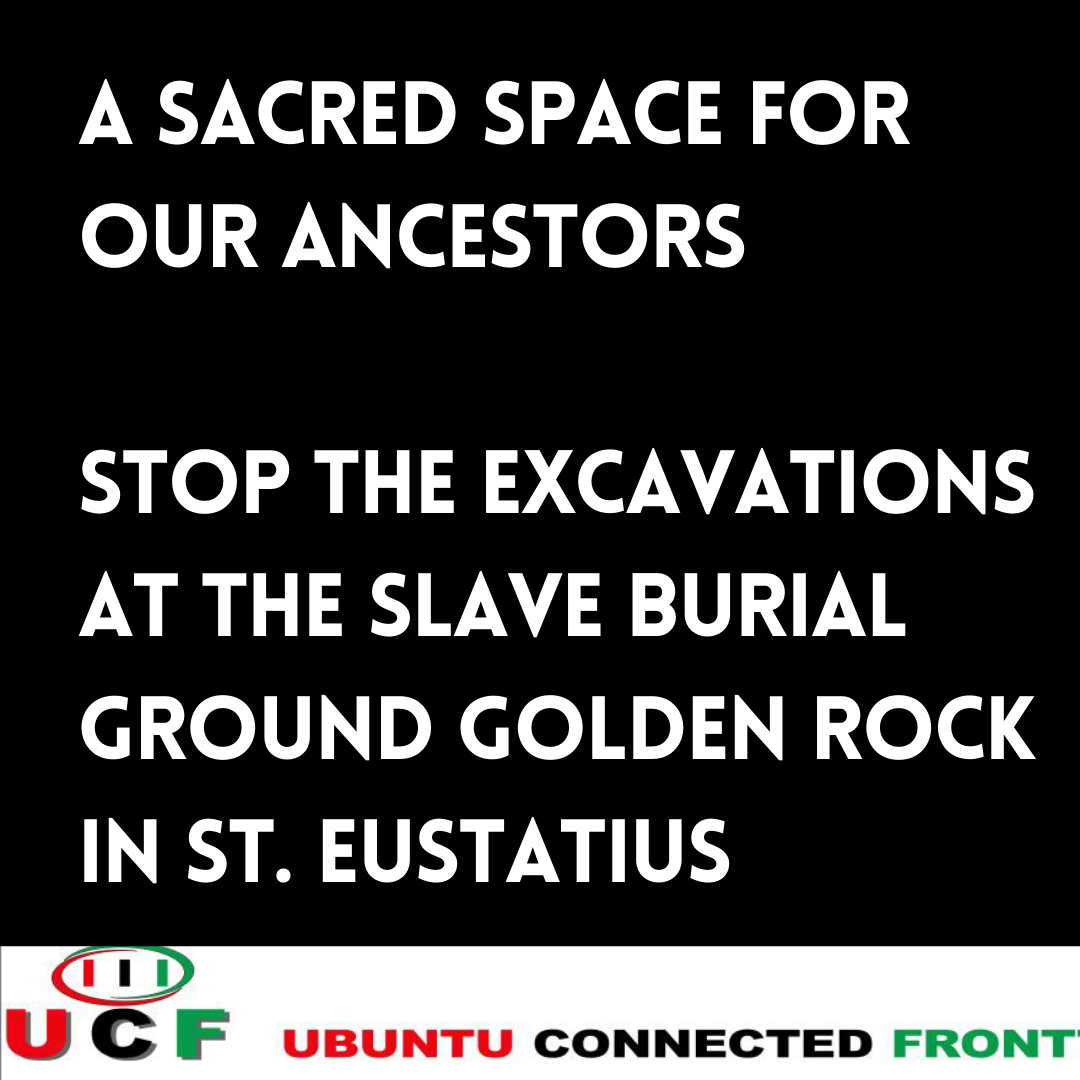
  1. Immediate cessation of our ancestors' excavation on this sacred ground;
  2. The submission of a written plan about the proposed excavation and commemoration of these ancestors that includes input from the community and scholars from the African diaspora;
  3. Adoption of a scientific research protocol which includes a definitive timeline for completion;
  4. Adoption of a commemorative proposal that is distinctive and rooted in African and African diasporic history and culture.  This commemorative proposal should include plans for the:
    1. respectful treatment of these ancestral remains;
    2. plan for their reburial at the original site of rediscovery;
    3. plan for the appropriate African centered ceremonies as selected by the descendant community;
    4. placement of a permanent memorial on the site of sacred ground (at the airport).
With regard to the assignment given to the team of archaeologists, we have the following questions:
  1. What exactly is the assignment given to the archaeologists by the government of St. Eustatius and where can we see it?
  2.  What are the exact research objectives and questions of the research team?
  3. What has been recorded about handling the human remains currently being excavated (will they stay on the island?)
  4. Several protocols exist for handling human remains during archaeological research. Under which protocols, regulations or laws are the current excavations taking place?
  5. Is there independent supervision of the execution of the excavations?
  6. What happened to the human remains of our ancestors exposed by erosion at the Godet site? SECAR does not provide information on this despite repeated inquiries.
  7. Is the Cultural Heritage Agency involved in the project, given the enormous historical significance of the cemetery for the whole world?
  8. The Transatlantic Slave Trade has been recognized by the United Nations as a Crime Against Humanity. Do you agree that an eighteenth century cemetery of free and enslaved Africans therefore demands special attention and treatment?
We would like to receive a response to these questions, thank you very much in advance.

Sincerely,

Kenneth Cuvalay, Chair Ubuntu Connected Front Tilburg

Xiomara Balentina, President Brighter Path Foundation St. Eustatius

George Berkel, Vice President of grassroot movement SEAD (St. Eustatius Awareness and Development Movement)

Teresa Leslie, Director Public Health Research EcoRAY

Cc
  • House of Representatives Committee on the Interior and Kingdom Relations (BZK)
  • House of Representatives Committee Education, Culture and Science (OCW)
  • The Cultural Heritage Agency of OCW

June 08, 2021

“A Sacred Space For Our Ancestors” | Online Mini-symposium | June 8, 2021


UCF Presents Online Mini-symposium “A Sacred Space For Our Ancestors”

Topics Symposium

Part 1 – Discovery of at least 18 remains of our ancestors at the beach of Godet

Part 2 – Africanism in the diaspora and Caribbean


When:  Tuesday, June 8 2021

Time:    4 pm Caribbean time, 16:00 European time

Where: Online Zoom 


Join us

Greetings and welcome to all our Afrikan Sisters and Brothers,

If you would like to participate in the Mini-symposium "A Sacred Space For Our Ancestors", please send us a message and we will send you the Zoom meeting details. 

  • Email cuvalay.kandidaat3/at/ubuntuconnectedfront.com 
  • Or use UCF Facebook messenger


Panel members

Host Kenneth Cuvalay, UCF Tilburg

Co-Host Zamir Ayubi, Bonaire, Chill-FM Radio

  • Derrick Simmons, former Commissioner of Constitutional Affairs St. Eustatius, BA Anthropology 
  • Dr Richenel Ansano, former director of the National Archaeological Anthropological Memory Management (NAAM), Curaçao
  • Drs Johnny Tujeehut, Specialty-Adult-education,Groningen, Academic level known as -Andragoog Curaçao 
  • Charles Woodley former-commissioner from 2017 to 2018 
  • Denicio Bryson, lawyer, St. Maarten 
  • Xiomara Balentina, psychologist and member Brighter Path Foundation, St. Maarten/St. Eustatius 
  • Regillio Vaarnold, chair UCF, Amsterdam, human rights lawyer
  • Melvin Sille UCF, Groningen 
  • Angelo La Cruz, Curaçao 
  • Chip Kwabena, fighter for Afrikan liberation, Curaçao/ St. Maarten and St. Eustatius 
  • Gilbert Bacilio, Curaçao 
  • Kenneth Cuvalay, from December 2009 to July 1, 2017, one of the principal founders of Mental Health Caribbean and clinical manager Mental Health Caribbean (MHC), UCF Tilburg

Guest speaker Part 1: Walter Hellebrand, Director of the Monument Foundation op St. Eustatius


Background

St. Eustatius is steeped in rich history. Recently, burial grounds of our enslaved ancestors were discovered at the former plantation Golden Rock. Because of erosion, also at least 18 remains were found at the beach of Godet. Archeologist worldwide are doing research on the island, under supervision of local Archeological Foundation SECAR. The community is not involved nor informed. Newspapers mention that the remains of our ancestors will be transported to the local museum after research is finished.

Archeology needs to decolonize, and we as African ancestors in the diaspora must be part of the process to make sure that the remains of our ancestors are treated with dignity and respect, and not treated as an artefact. See the inspiring example of the “African Burial Ground” in Manhattan, New York here: https://www.nps.gov/afbg/index.htm

Program, Introduction

All panel members will introduce themselves briefly


Program, Part 1 - Addressing our ancestral remains

Mr Walter Hellebrand is involved with the location of the historical location of many of our ancestors resting places on the island and presents the situation;

  1. Giving a description of the current situation regarding the removal of our Afrikan ancestors remains, how much, how far is the community and partner organizations are been informed or even are involved?
  2. Is it known as to which government is responsible for making decisions as to what is eventually going happen to our ancestors remains and where would be there final resting is going to be place?
  3. There are rumors that the remains of our ancestors would be placed partly possible to seen online, is this true, how much do you know about this?


Program, Part 2 – Africanism in the diaspora and Caribbean

Mr. Derrick Simmons presents the situation giving insight to the happenings on the ground;

  1. Impact on a people and their community since there democratically elected government was dissolved in 2018 and their democratic rights, self-determination and freedom to elect their own government was taken away by the Dutch colonial powers.
  2. As far as you know which government is in charge as to what is taking place, is it the central government in the Hague or is it the undemocratic appointed so call local government which been installed by the colonial Dutch powers that has the region in its grip? 
  3. Is there financial mismanagement and corruption on the island by the Dutch, the issues which the democratically elected government of the people of St. Eustatius was dissolved on by the Dutch?
  4. As we know the island government of the people of St. Eustatius was dissolved on the thums up charges by the so called three wise men report and an undemocratic appointed so call local government has been installed by the colonial Dutch powers that has the region in its grip?

Mr. Denicio Bryson, lawyer:

  • He will have 10 minutes to present the situation the regarding on St. Maarten, taking steps going to the UN against the Dutch domination and how their action coo insides with that of St. Eustatius.


The final aim of this symposium is the following

  • How we people of African descent reclaim our culture heritage which are being continue to be stolen and take the control of rewriting of our history which continues to be written and distorted by white historians and as Afrikans give direction and input to the narrative from our African perspective?
  • We are also seeing a mass development among white scholars promoting themselves and graduating on the issues of anti-racism from their position from the lens of white privilege.
  • We Afrikans we still continue to live the pain and suffering and effects as a consequence of the legacy of Dutch Transatlantic slavery and colonialism within the systems, Eurocentric education, discriminatory legislation, within the institutions at large, statues which present images of which illustrate white supremacy over Afrikaans the portrayal as inferior in public spaces which has damaging image forming on our children self-esteem,
  • Shouldn't we be determining our narrative and if so, how do we collectively come together and develop that process and also determining the narrative of anti-racism and not the other way around?

After the presentation we will all have together with the other speakers' integral discussions with their input hoping we can conclude collective answers and solutions taking us forward building a future determined by us while changing the false historical and distorted history of our ancestor's historical narrative. In other words, we are the one absolutely responsible for our historical story and the narrative of it.